
#26. Four Giants in American Fashion: Trigère, Norell, Galanos and James
- Jessica C
- Apr 7, 2024
- 3 min read
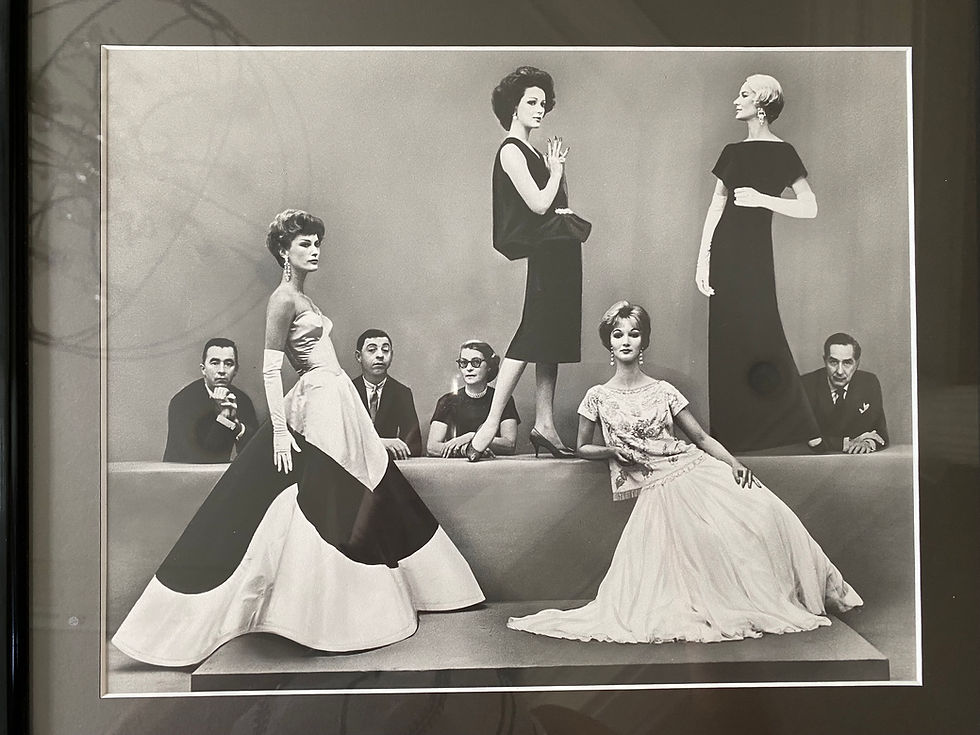
One of the most stunning portraits of Pauline Trigère was this 1958 photography by Sharland for The New York Times.
This black and white photograph featured the four giants in American fashion alongside their creations: Charles James, James Galanos, Pauline Trigère and Normal Norell.
Since my book is solely devoted to Pauline Trigère, I use this particular blog to chronicle contemporaries of Pauline, note all are male designers except for Pauline.
Charles James was born in 1906 in England. Two years older than Pauline, Charles was known for his extravagant ball-gowns that are red-carpet worthy. His mother came from a wealthy Chicago family. As a late teenager, the family moved to Chicago, and he worked at an architectural design department where he acquired the mathematical skills that enabled him to create flat patterns on the garments. He opened a milliner shop at nineteen years of age under the name of “Charles Boucheron”. In 1928, he moved to Long Island and continued his millinery shop. He was credited with the “taxi dress”: so, named because it is “so easy to wear it could be slipped on in the backseat of a taxi.” Six years later, he moved to Mayfair, London and designed the wedding dress for Cecil Beaton’s sister, Baba. In 1936, he officially set up the design company under his own name.
Primarily known as a “sartorial structural architect”, his collections were sold at Bergdorf Goodman and Lord & Taylor. Many years later with accolades ranging from Coty Awards and Neiman Marcus Award, Charles was included in this photo with the “Four-Leaf” ballgown. He considered it his best creation. This iconic dress weighted 12 pounds and is supported by an inner rigid structure.
James Galanos was born in 1924 in Philadelphia of Greek-born parents. He was the youngest designer to win the Coty Fashion Award in 1954. He dressed the elite of America’s cinama royalty, Elizabeth Taylor, Marilyn Monroe, Rosalind Russell, Jackie Kennedy, Diana Ross, Marlene Dietrich. In the political arena, Galanos was considered Nancy Reagan’s favorite designer. Nancy met Galanos when she was working as an actress in Hollywood. Subsequently Nancy wore Galanos to Ronald Reagan’s inaugural ball as governor of California in 1967. The French couturier Hubert de Givenchy once exclaimed about one of Galanos’s gowns after looking at the inside of the dress: “…we don’t make them this well in Paris!” Galanos retired after nearly fifty years in the fashion industry. However, he was almost equally verbal as Pauline in stating his opinion. Eric Wilson, fashion reporter of The New York Times recalled that Galanos once exclaimed in contempt at the state of fashion: “How many women can wear just a patch over their crotch and bra?”
Galanos’s vintage gowns remain highly sought after even today. He donated the bulk of his collection to Drexel University in 2016, one month before his passing at age 92. Galanos and Trigere had a joint celebration gala in 1959, when both were inducted into the Coty Hall of Fame. Pauline and Galanos were friends and there were several correspondences found between them which showed their friendship.
Norman Norell was born in Noblesville, Indiana in 1900 and moved to New York City to study fashion at Parsons School of Design and Pratt of Institute. He spent twelve years with Hattie Carnegie as a designer, where Pauline worked as a designer briefly as well. He established his own firm in 1960 on Seventh Avenue. He had numerous top-tier clients including wealthy socialites, Hollywood stars and wives of major industrialists and politicians. Norell was the recipient of the first fashion industry critic’s Coty Award, and he was compared as rivals to Parisian fashion firms. Marilyn Monroe’s wedding dress for her marriage to Playwright Arthur Miller was designed by Norell. Norell mentored younger designers including Bill Blass and Stephen Sprouse.
Norell was the first American fashion designer to launch his own brand of perfume in 1968. Marketed by Revlon and sold at $50 an ounce, it was very successful and earned Norell enough funds to purchase the shares of his company from silent partners.
Easy-going with a calm demeanor, Norell lived a quiet life in New York City. He suffered a stroke the day before his exhibition opening at the Metropolitan Museum of Art on October 16, 1962. He died 9 days later.
This stunning portrait by Sharland for The New York Times captures the four giants in American Fashion, each represented with their signature garment and the impact they had on the industry. I invite you to read my other blog posts chronicling my research journey into the life and work of Pauline Trigère.


Comments